EuCIA is pleased to announce the successful conclusion of the first General Assembly of the European Circular Composites Alliance (ECCA), held in Brussels on 4th December. The event brought together more than 100 participants from across Europe to collaborate on strategies for advancing the circularity of composite materials.
Since its launch in March 2025, the ECCA has welcomed more than 180 organisations, reflecting the industry’s commitment to establishing a circular economy for composites. The alliance’s work will be closely aligned with key EU policy frameworks, including the Green Industrial Deal and the Circular Economy Act, and this General Assembly marks a significant step in the ongoing dialogue between EuCIA and the European Commission, ensuring that the value of composites is recognised and supported in future regulations.
“Composite materials are essential for Europe’s green transition, but we lacked a coordinated roadmap to make them circular, competitive, and compliant with evolving EU policies,” explained EuCIA’s President, Professor Roberto Frassine, in his opening speech. “Inspired by the Circular Plastics Alliance and supported by founding partner JEC, the ECCA was established as a unified platform for composites circularity, bringing together all stakeholders to drive collective action and speak with one voice to the external world.”
ECCA’s objectives include:
- Uniting a fragmented landscape by coordinating circularity initiatives across market sectors;
- Accelerating scalable circular solutions, driving technology development, harmonisation and industrial scale-up;
- Shaping EU legislation through proactive engagement with policymakers;
- Connecting materials producers, manufacturers, waste collectors, recyclers, end-users, researchers, and policymakers to build a truly circular ecosystem for composites.
Keynote speakers and policy context
The launch of the ECCA comes at a time when circularity is moving to the heart of Europe’s industrial policy and competitiveness agenda. The new Circular Economy Act is a major initiative, aiming to accelerate the transition to a more circular economy, increasing the EU’s economic security, resilience, competitiveness and decarbonisation. Due for adoption in 2026, it seeks to establish a Single Market for secondary raw materials, increase the supply of high-quality recycled materials and stimulate demand for these materials in the EU.
To discuss this policy context, we were honoured to host two guest speakers from the European Commission:
- Stefano Soro, Head of Unit, Directorate-General for Internal Market, Industry, Entrepreneurship and SMEs (DG GROW);
- Linos Voskarides, Policy Officer, Directorate-General for Maritime Affairs and Fisheries (DG MARE).
Stefano Soro: “Circularity remains a core pillar of the Clean Industrial Deal – President von der Leyen has been very clear on this. It is both a foundation of sustainability and a way to manage Europe’s strategic dependencies. The upcoming Circular Economy Act in 2026 will reinforce this direction. For Europe to strengthen its industrial autonomy, safeguard high-value jobs, and reduce external dependencies, composite materials must become truly circular.”

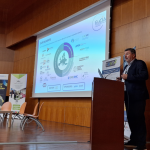
Stefano Soro, Head of Unit, DG GROW, at the ECCA General Assembly on 4th December.
(Picture © Sébastien d’Halloy / EuCIA.)
Linos Voskarides: “If we want to achieve a viable circular economy for composites, then the entire sector needs to work together. Recycling of composites should be included in the Circular Economy Act, including provisions for recycling end-of-life recreational boats. Since the recycling model of the recreational boats alone cannot be profitable, its scope should be extended to the entire composite industry. In addition, for the forthcoming EU Ports Strategy, we should consider integrating recycling facilities in the ports. In this way we will recognise ports as key hubs for composite waste management and circularity. In a similar way, we could also consider the integration of the composites recycling in the forthcoming EU Industrial Maritime Strategy.”
Composites circularity is of course a global challenge and the audience learned about the evolving American circularity landscape for composites from Cindy Squires, President & CEO, American Composites Manufacturers Association (ACMA), while Chris Skinner, VP Strategic Marketing and R&D, Owens Corning, explored what needs to be done to make circularity the new strength of composites.
Cindy Squires: “Circularity will only succeed if the economics work. We must shape the market rules, ensure fair competition, and protect our industry from being undercut by cheap imports. Continued transatlantic coordination is essential – for example, to establish dedicated HTS codes for recycled composite products.”
Chris Skinner: “If we want circularity to become a real strength of our industry, we must start by fixing our own house. We still discard nearly 10% of our glass fibre before it even leaves the factory. And as long as images of buried wind blades circulate, our narrative collapses. We need structural solutions that keep composite materials in the economy – circularity is a system we must build.”
Action plans
The General Assembly also featured presentations from ECCA’s five Working Groups, which have been active since August 2025:
- Aerospace & Defence;
- Road Vehicles & Public Transportation;
- Industrial & Recreational;
- Construction;
- Cross-Over (fostering synergies across the groups, and addressing barriers at EU and national levels).
Each group presented its objectives, challenges, and action plans for 2026 and beyond. Afternoon workshops provided an opportunity for in-person collaboration, and the day concluded with a panel discussion led by Malcolm Forsyth, Sustainability Manager at Composites UK. The panel underscored the urgency for the entire supply chain to work together to overcome barriers to circularity, reduce environmental impact, and support the competitiveness of European industries.
Looking ahead
The next ECCA General Assembly will take place in Brussels on 3rd December 2026, offering a chance to review the alliance’s progress in turning collective ambition into concrete action.
During the coming weeks, EuCIA will share further details about the Working Groups’ objectives and plans.
Join us!
We welcome new members. For more information about the ECCA’s objectives and how to join please visit the EuCIA website: ECCA – EuCIA.
Thank you to our partners