Vidar Nyhammer explains how NCMT is supporting the development of the Norwegian composites industry and its transition to circular value chains.
What is NCMT?
As a key player in the Norwegian industry, NCMT serves as a unified voice for polymer and composites industry stakeholders across Norway. The association brings together companies of various sizes, working with different materials and different production methods, and working within different sectors of the polymer and composites industry.

Thomas Drustrup, leader of Plastindustrien (Denmark), advocating for an increased Nordic collaboration at NCMT’s annual conference in 2024.
What is your strategy?
NCMT’s strategy aligns with the growing focus on circularity, sustainability and industrial development through transparent collaboration. With a focus on being an active participant in the development of the industry, NCMT’s engagement ranges from creating a scaffolding around the members’ internal development and collaboration with researchers, to increasing the society’s general knowledge about plastic and composite materials and solutions.
What are your key initiatives related to sustainability?
Sustainability stands at the forefront of NCMT’s activities. The association actively participates in various initiatives focusing on industrialising circular economy solutions, increasing the data foundation for waste management, and positioning plastic and composite materials as sustainable solutions in new sectors.
The range of initiatives includes the following:
- Collaboration with industry partners to develop sustainable end-of-life solutions for composite materials, and to include secondary raw materials in production.
- Active participation in waste management discussions and initiatives related to extended producer responsibilities.
- Developing a database where waste volume data can help NCMT members to establish predictable circular value chains from production waste.
- The establishment of the European Composite Bridge Database, which will provide a quantitative and qualitative data foundation enabling composite bridge manufacturers to provide enough information for a smooth approval process, and a better position in the construction industry.
How does being a member of EuCIA assist you in your work?
Firstly, it is important to not underestimate the general value of a network of highly engaged and competent industry professionals. In the case of EuCIA I would argue that this network often leads 1 and 1 to become 3 on behalf of the industry.
More specifically, being a member of EuCIA provides NCMT with valuable opportunities for international collaboration and two-way knowledge sharing. As a national association we get information about the latest developments internationally. At the same time we’re able to put our members’ challenges on a European agenda.

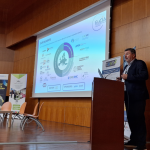
Vidar Nyhammer on stage at JEC Composites Talks Nordics together with Eric Pierrejean (JEC) and Christian Borch (programme host).
The composites industry faces many challenges that demand international collaboration, with circularity being one of the most pressing. To successfully transition to circular value chains, we must work together across Europe, addressing everything from technology and data collection to waste management and the downstream integration of secondary raw materials.
Where do you see your association in 10 years from now?
As a new organisation, hence a new player in the plastics and composites industry, NCMT is still at a stage where we aim to improve our position both internally in the Norwegian plastic and composites industry, and among other stakeholders.

NCMT members Jon Inge Brattekås (CSUB) and Alf Egil Jensen (Fireco) presenting the Paradis Bridge at the JEC Summit on Building and Infrastructure
We’re both building our internal capacity, growing our members base, and facilitating development in the industry.
Close to 95% of NCMT’s members from the composites industry are SMEs. It’s crucial for their survival that they have the ability to adapt to the rapidly changing regulations and increased demands for circular systems and collaboration. In the coming decade NCMT expects to play the role as the main junction for the circular transition of the composites industry in Norway.
To enable circularity we’ll focus on gathering data, facilitating collaboration and increasing knowledge and competence. We believe that this will help our industry to within the next 10 years to have widely implemented the use of secondary raw materials.
Further information: www.ncmt.no
 From the establishment of NCMT in 2021, Vidar Nyhammer as general manager has formed NCMT to the cluster it is today. Vidar is passionate about the environment and is therefore engaged in both how the industry can limit its emissions and environmental impact, and also to communicate how and where we benefit from plastic and composite materials. Outside of work, Vidar can often be spotted in the mountains and woods of Western Norway, most likely climbing a rock wall or riding his mountain bike.